

Future-Proofing Urban Infrastructure: Designing Utility Systems for a Smart City Project
Cities are growing in complexity at a rapid pace. Rising populations, shifting climate conditions, and technological advancement are fundamentally reshaping how urban areas function. Infrastructure development must keep pace with this transformation. A smart city project demands more than digital connectivity. It requires physical systems built to handle present-day demands while remaining adaptable to future unknowns.
Utility networks sit at the core of this challenge. Underground conduit systems, power distribution grids, and data transmission pathways form the nervous system of modern cities. Designing these systems with longevity in mind is not a luxury. It is a fundamental requirement for any city that intends to remain functional and competitive in the decades ahead. Getting the foundational design right from the start is what separates cities that scale effectively from those that face chronic bottlenecks.
Understanding the Scope of Smart City Utility Demands
Smart cities rely on layered infrastructure. Power, data, water, and communications networks all share underground corridors in dense urban environments. Poor planning at the design stage creates costly conflicts during construction and ongoing operations.
Engineers must account for current load demands while also anticipating growth. A municipality housing 10,000 residents today may serve 50,000 within two decades. Utility conduits sized for present needs become bottlenecks quickly. Planning ahead eliminates the need for disruptive system overhauls.
Redundancy is another essential factor in utility system planning. A single point of failure in a utility network can disrupt entire districts for extended periods. Incorporating multiple pathways and fail-safe mechanisms into the original layout prevents expensive retrofits. It also lowers the operational risk associated with aging, single-path infrastructure.
The Role of Underground Systems in Urban Resilience
Above-ground utility lines are inherently vulnerable. Storms, vehicle accidents, and aging poles create service interruptions that are costly and disruptive. Cities investing in underground networks gain substantial long-term reliability. They also reclaim visual space and lower ongoing maintenance demands.
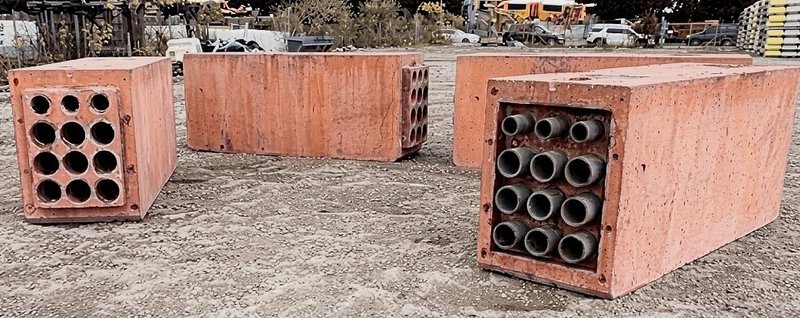
Precast concrete enclosures and encasements protect electrical conduits and fiber optic cables. They allow multiple utilities to share a single corridor beneath streets and sidewalks, maximizing use of limited right-of-way.
These precast products serve a dual purpose. First, they shield critical infrastructure from physical damage and moisture intrusion. Second, they enable future upgrades without major excavation. Technicians can pull new cables through existing conduits as technology evolves. This saves significant time and money over the life of the system.
This adaptability is especially vital in the context of smart city development. Sensor networks, EV charging stations, and 5G cabling all require conduit access. Accounting for these additions during the initial construction phase avoids repeated street cuts and extended service interruptions. It also lessens the cumulative impact on urban traffic and commerce.

Designing for Flexibility and Future Technology Integration
A smart city project does not have a fixed endpoint. Technology keeps advancing. The infrastructure supporting it must be built with genuine flexibility in mind.
Modular design principles help achieve this goal. Components that can be replaced or expanded independently allow engineers to upgrade one system without disturbing adjacent ones. Standardized conduit sizing, consistent vault placement, and well-documented routing all contribute to lasting adaptability.
Several key design principles support future-ready utility systems:
- Oversized conduit runs that accommodate additional cabling without excavation
- Standardized junction vault dimensions that accept new hardware as technology evolves
- Dedicated pathways for data infrastructure separate from power systems to minimize electromagnetic interference
Early coordination between engineers, city planners, and utility providers adds considerable value. When teams align on routing, depth, and load requirements before construction begins, field execution becomes far smoother. Conflicts get resolved on paper rather than in the ground, where changes are exponentially more expensive.
Documentation is also a critical element of flexible design. Accurate as-built records of conduit routing, depth, and capacity allow future engineers to plan upgrades with confidence. Gaps in documentation force unnecessary exploratory excavation. This adds cost and delays to what should be straightforward maintenance tasks.
Material and Manufacturing Considerations for Long-Term Durability
Materials matter as much as design intent. Utility infrastructure must perform for decades in demanding conditions. It faces soil movement, groundwater exposure, freeze-thaw cycling, and heavy surface loads from vehicles and pedestrians above.
Precast concrete has become a widely accepted material choice for underground utility systems. It is fabricated under controlled factory conditions, ensuring uniform quality across each component. Field-cast concrete is subject to variable curing and weather conditions. Precast eliminates that variability.
Dimensional accuracy is another key advantage. Precast components are produced to tight tolerances. This streamlines installation and reduces alignment errors in the field. Fewer adjustments on-site translate directly to shorter construction windows and reduced labor expenditure.
Structural load ratings are standardized during precast fabrication. Engineers can specify the exact capacity needed for each application. A duct bank running beneath a major arterial road requires very different structural characteristics than one installed under a bike path. Precast manufacturing handles both scenarios with precision.
For any smart city project, the durability of underground components determines how reliably a city's digital backbone performs. Selecting materials engineered to last lowers lifecycle costs and minimizes future maintenance-related disruptions to urban activity.
Partnering With Roman Stone for Smart City Infrastructure
Infrastructure designed today will serve communities for generations. The choices made at the planning and procurement stage determine how resilient, well-suited, and cost-effective a city's utility network will be over its lifespan.
Roman Stone specializes in precast concrete solutions for complex infrastructure projects. Our offerings include duct banks, underground enclosures, and custom-engineered components designed for utility and smart city applications. Each piece is manufactured in a controlled facility to meet precise engineering specifications.
Every day, we work alongside contractors, utilities, and public agencies from early planning through final delivery, identifying and addressing challenges before they escalate in the field. In fast-paced projects with high execution demands, a manufacturing partner with deep infrastructure expertise provides real competitive advantage.
Ready to accelerate your next smart city utility project? Connect with us to learn how precast solutions can support your next smart city utility project.
FAQ
What are key challenges engineers face when coordinating multi-utility underground installations in urban areas?
Dense urban environments offer limited right-of-way. Multiple utility types must often share narrow corridors. Engineers must carefully sequence installations and use multi-utility duct systems to prevent conflicts. Coordination with municipalities and neighboring utility operators is essential from the earliest planning stages.
How do soil and groundwater conditions influence the selection of underground utility materials?
Aggressive soils and high groundwater tables accelerate corrosion in many traditional materials. Precast concrete offers natural resistance to these conditions. Proper mix design and reinforcement detailing extend service life. Geotechnical assessments should be conducted early to match material specifications to site-specific conditions.
What regulatory standards typically govern underground duct bank systems?
Several standards apply depending on jurisdiction and application. These include the National Electrical Code (NEC), ASCE guidelines, and various state transportation agency specifications. Local utility authorities often impose additional requirements. Engineers must review all applicable standards early in the design process to avoid permitting and inspection conflicts.
