
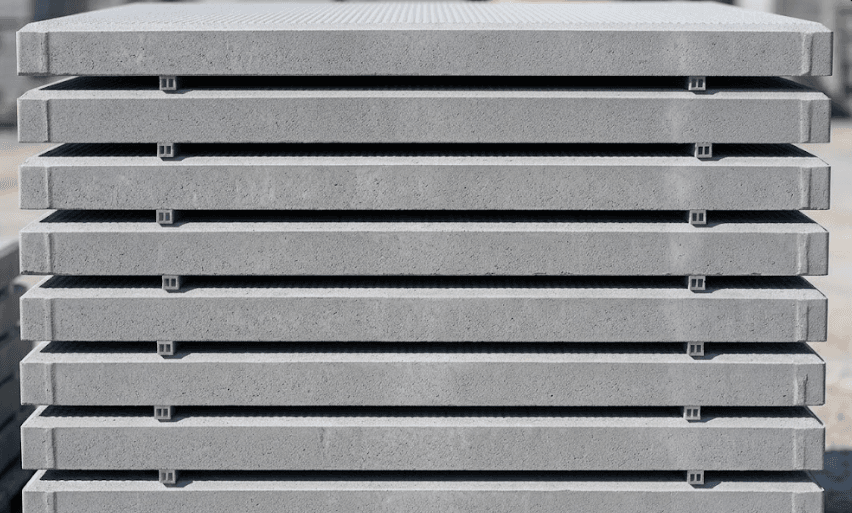
Cost-Effective Paving: When Precast Paving Slabs Make Financial Sense
Infrastructure budgets face constant pressure across every sector. Project owners and contractors must deliver durable results without overshooting financial limits. Paving slabs made from precast concrete have become a practical answer to that challenge, though not every application is an obvious fit. Understanding when they genuinely make financial sense requires moving beyond unit price. It means examining installation speed, workforce demands, and long-term maintenance obligations as a complete, interconnected picture.
Understanding the True Cost of Paving Slabs Projects
Sticker price is a starting point, not a conclusion. Many procurement teams evaluate options based on material cost per square foot. That approach seems practical. In reality, it often leads to costly surprises once construction begins.
Cast-in-place concrete involves formwork setup, extended curing periods, and significant on-site crew hours. Weather interruptions push timelines and inflate invoices. Each variable introduced at a jobsite is a potential source of additional expense.
Conversely, precast slabs arrive at the site ready for placement. The manufacturer completes the work offsite in a controlled setting. That shift removes multiple cost variables from the field and simplifies execution considerably.
A complete cost assessment for any paving initiative should account for:
- Raw material and fabrication costs
- On-site crew hours and equipment use
- Site preparation and subgrade requirements
- Projected maintenance expenses over the asset's service life
- Schedule impact, including downtime and disruption costs
When evaluators consider these elements together, the total cost comparison often shifts toward precast. The upfront difference in unit price frequently narrows or disappears once decision-makers include all contributing factors.
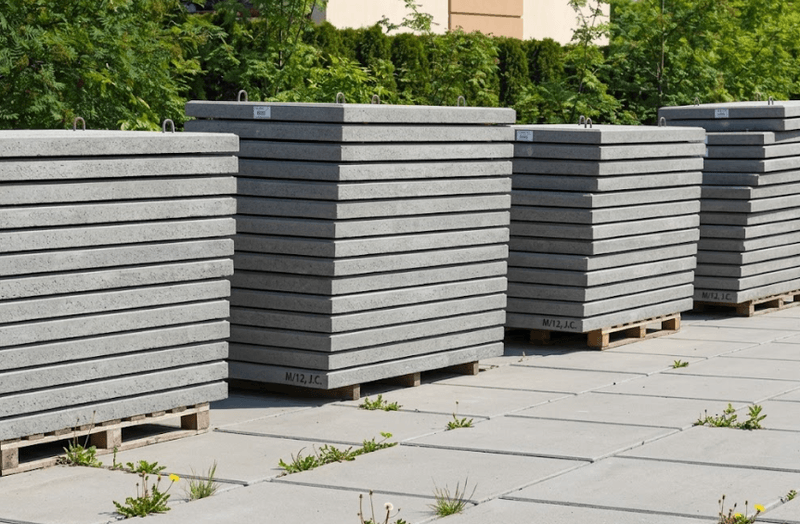
Where Precast Paving Slabs Deliver the Most Value
Precast paving delivers its strongest financial case in specific contexts. High-traffic environments, dense urban areas, and repetitive construction programs are among the clearest opportunities.
In cities, every additional day of site activity carries a financial burden. Road closures affect local commerce. Pedestrian detours create liability. Faster placement limits exposure to all of these concerns.
Utility corridors and data center campuses present a different but equally compelling case. These settings demand precise, repeatable work. Precast manufacturing produces dimensionally consistent units. That consistency limits field corrections and avoids rework entirely.
Programs with large volumes of identical sections benefit from economies of scale. Once designers finalize a slab design, per-unit production costs drop as volume increases. Contractors and owners who plan for this dynamic ahead of time tend to capture the most savings.
Labor and Schedule: The Overlooked Cost Drivers
Workforce availability is one of the most unpredictable variables in modern construction. The availability of skilled concrete workers affects both budget and schedule in ways that are difficult to anticipate.
Precast manufacturing relocates a significant portion of the concrete work to a factory environment. This approach reduces the number of specialized tradespeople required at the jobsite. Fewer specialists on-site means lower hourly expenditures and fewer coordination challenges.
Placing precast slabs demands less technical expertise than pouring and finishing concrete on an active site. General construction crews can handle placement with minimal additional training. That accessibility broadens the available workforce and lowers associated wage rates.
Faster installation shortens the overall build timeline. For contractors facing liquidated damages clauses, schedule compression carries direct financial value. For public agencies managing community concerns, it limits the duration and scope of disruption.
Time and workforce efficiency are closely linked. Improving one tends to advance the other. Precast paving addresses both levers at once.
Long-Term Value and Lifecycle Thinking
A paving option with a low initial price but frequent repair needs is not a sound financial choice. Lifecycle cost is the more accurate and meaningful measure of value.
Precast concrete is produced under quality-controlled conditions. The result is a more uniform product than what can typically be achieved during field pours. Greater uniformity leads to a longer service life and fewer maintenance interventions over time.
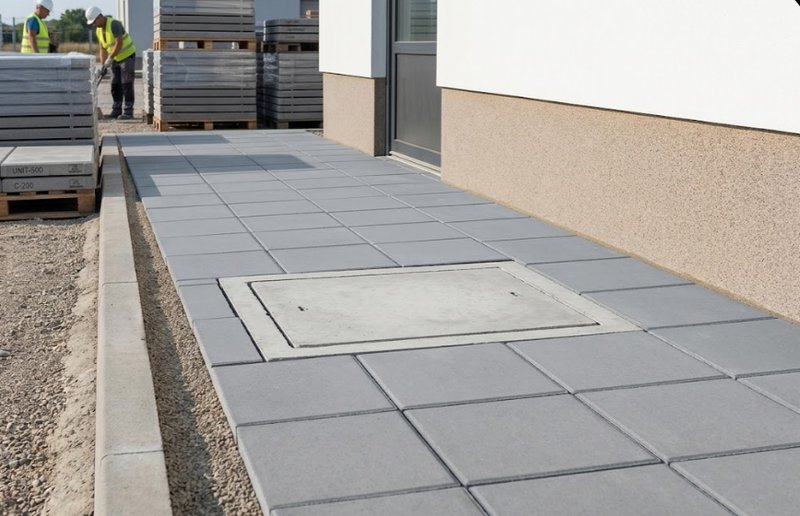
Individual slabs can be removed and swapped out without disturbing adjacent sections. This targeted approach avoids the expense of full-section removal and repaving. The cumulative savings over a multi-decade asset life can be substantial.
Infrastructure owners increasingly factor longevity into procurement decisions. A higher-quality product with an extended service life often justifies a greater initial expenditure. Durability is an economic attribute, not simply a technical specification.
Evaluating the long-term picture means examining several key considerations:
- Anticipated frequency and scope of maintenance work
- Ease of accessing or replacing individual units
- Expected performance under actual load and environmental conditions
- Compatibility with future utility access or system upgrade requirements
This framework transforms the evaluation from a simple price comparison to a strategic capital decision.
Building the Right Precast Partnership
Selecting a manufacturing partner influences more than product quality. Lead times, engineering support, and delivery coordination all affect total program economics.
Roman Stone has partnered with contractors, utilities, and public agencies on complex infrastructure builds for more than a century. Our manufacturing process centers on precision and consistent output. Both qualities limit complications during installation and the expenses that follow.
Our engineering team engages with stakeholders during the planning phase. Early involvement surfaces cost-saving opportunities before those windows close. It also ensures that slab specifications reflect actual site demands and structural requirements.
For teams managing tight fiscal parameters and demanding schedules, a responsive, capable precast manufacturer is a real competitive advantage. Roman Stone's operations are built to support exactly that kind of delivery. Reach out today to find out how precast paving slabs can bring greater cost certainty to your next infrastructure build.
FAQ
What factors most influence the cost of precast paving?
Volume, slab complexity, delivery distance, and site access conditions are the primary cost drivers. Programs with higher volumes and straightforward designs tend to see the best per-unit economics.
How does precast concrete paving perform in severe weather?
Precast concrete is manufactured to meet specific strength and durability standards. Proper mix design and controlled curing produce slabs that hold up well in freeze-thaw cycles, high heat, and heavy precipitation.
Is precast paving compatible with utility access needs?
Yes. Slabs can be engineered with removal configurations or access points that accommodate underground utility systems. This makes precast a viable option in areas where future subsurface work is anticipated.
