
Sustainable Construction: How Precast Products Reduce Environmental Impact
The construction industry ranks among the largest contributors to global carbon emissions. It accounts for nearly 40% of total worldwide emissions (UNEP). That figure covers both operational energy use and the carbon embedded in material production. Sustainable construction is no longer a trend or a marketing phrase. It has become a standard the entire industry must meet.
Precast concrete has emerged as a powerful tool for lowering construction’s environmental footprint. Manufactured off-site in controlled factory settings, precast products offer distinct benefits over traditional on-site methods. Understanding those benefits helps contractors, engineers, and project owners make smarter, more responsible decisions.
The Environmental Cost of Conventional vs Sustainable Construction
Traditional on-site construction is resource-intensive. Workers mix and pour concrete in open-air conditions, often generating more material than a project requires. Delivery sequencing problems, unexpected delays, and shifting weather lead to wasted batches of ready-mix concrete.
Material overuse sends enormous volume to landfills each year. Equipment runs longer to compensate for inefficiencies. Fuel consumption rises.
These are not isolated incidents. The global construction sector produces an estimated 2 billion tons of construction and demolition waste annually. That figure accounts for roughly one-third of all solid waste generated worldwide. A substantial portion traces directly back to avoidable overproduction and poor resource management.

How Precast Production Cuts Waste and Emissions
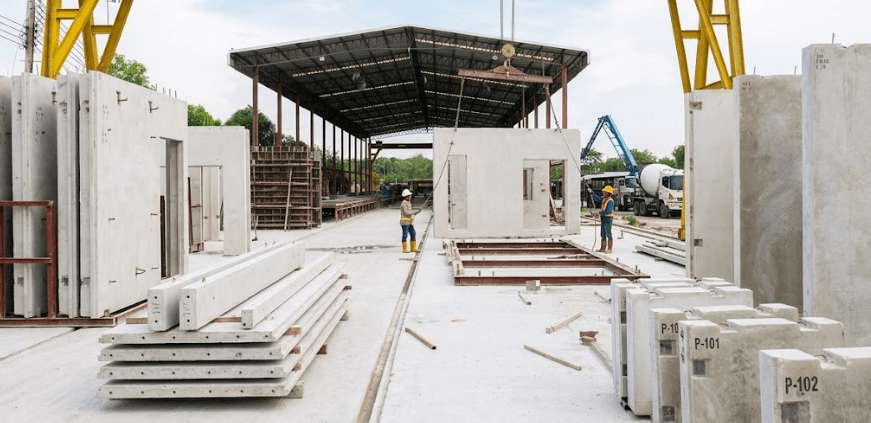
Precast manufacturing takes place in quality controlled facilities. This production environment creates measurable improvements in both material efficiency and emissions output.
Precise measurements prevent overuse. Excess material gets recycled back into the production cycle rather than discarded. Weather-related delays that trigger wasted batches are no longer a variable. Every component is manufactured to specification before it reaches the project site.
Water usage is also lower in controlled settings. Precast facilities don’t need additional water to protect fresh concrete from heat or rapid drying. That is a meaningful difference in high-temperature or arid climates where on-site pours routinely require excess water throughout the curing process.
Durability, Longevity, and the Full Lifecycle Advantage
Sustainability isn’t only about what goes into a material. It is also about how long that material continues to perform.
Precast concrete is engineered for extended service life. Its structural density and factory-cured strength make it highly resistant to weathering, freeze-thaw cycles, and heavy load requirements. A longer-lasting component means fewer repairs, fewer replacements, and less cumulative resource consumption over time.
This is where the lifecycle perspective becomes particularly compelling. A structure that performs reliably for decades carries a far smaller environmental footprint than one requiring frequent intervention. Precast elements can also be designed for disassembly. Rather than demolition and disposal, components can be relocated or repurposed at the end of a project phase. This reduces demand for new raw materials and limits solid waste generation.
Thermal mass adds another layer of long-term value. Concrete absorbs and releases heat gradually. This characteristic helps regulate interior temperatures, cutting mechanical system loads and lowering operational energy use throughout a structure’s working life.
Supporting Green Standards and Certification Goals for Sustainable Construction
Many infrastructure and building projects are now measured against formal sustainable construction benchmarks. LEED certification is among the most widely recognized. Precast concrete contributes to multiple credit categories within these rating frameworks. This makes it a strong fit for teams with green project targets.
Here are the primary areas where precast products align with established certification requirements:
- Reduced site disturbance. Precast limits on-site activity, minimizing soil disruption and stormwater runoff.
- Recycled content. Many manufacturers incorporate fly ash, slag, or recycled aggregates into mix designs, lowering embodied carbon in the finished product.
- Indoor environmental quality. Concrete’s natural density provides effective sound attenuation and supports healthier interior conditions.
- Energy performance. Thermal mass properties help structures meet recognized energy efficiency targets.
- Materials and resources. Factory precision reduces jobsite waste and keeps pollutants out of the surrounding environment.
Teams pursuing LEED, BREEAM, or similar ratings also benefit from the traceable production data that factory manufacturing provides. Every batch is monitored. Each mix is documented. That level of accountability supports the rigorous verification these programs require.
Specifying precast also streamlines the documentation process. Manufacturers produce consistent, testable components with known performance profiles. That predictability simplifies the reporting work that certification requires.

Building Greener Infrastructure With a Trusted Precast Partner
Infrastructure teams face tight schedules, labor constraints, and growing environmental accountability. The choice of a precast partner directly shapes project outcomes. The sustainability benefits of precast concrete only fully translate when manufacturing quality, engineering precision, and responsive coordination come together.
Roman Stone has spent more than a century helping contractors, utilities, and public agencies deliver complex infrastructure projects. Our manufacturing approach is grounded in principles that make precast a genuinely responsible choice. We prioritize precision, controlled production, and the reduction of variables that cause waste and rework on active sites.
Shifting critical work off the job site and into a controlled setting isn’t just a scheduling benefit. It is an environmental one. Contact Roman Stone today to discuss how precast solutions can support your sustainability objectives and keep your timeline on track.
Sustainable Construction & Precast FAQs
Can precast concrete support net-zero building goals?
Yes. Precast contributes to net-zero targets in several ways. Manufacturers can integrate supplementary cementitious materials to lower embodied carbon. Its thermal mass properties also reduce operational energy demand over time. Roman Stone, for instance, will soon offer the entire EZ-KEY line with a special reinforcement; and a carbon-negative concrete mix option to support carbon neutrality.
How does precast manufacturing affect air quality near project sites?
Controlled production significantly reduces on-site dust, diesel emissions, and particulate matter. Traditional construction requires extended equipment operation at the site, generating more localized air pollution. Precast minimizes the active footprint at the project location, which leads to cleaner conditions for workers and nearby communities alike.
What role does precast play in managing stormwater on construction sites?
Since precast components arrive ready to install, on-site grading and ground disturbance are kept to a minimum. Less disturbed soil means less erosion and sediment runoff into nearby waterways. Some precast products can also be engineered with permeable or drainage-integrated features to actively support stormwater management requirements on a completed project.

